
A special shape paper box is feasible exactly when it can be die-cut from a flat sheet and closed with a single straight seam. Compound curves and heat-formed shapes are outside paperboard, and everything else — how exotic the silhouette looks — is a question of cost, not process. The mistake most briefs make is drawing the outside first and asking whether it can be made; the workable order is inside first: pans, mirror, magnet positions, then the shape that contains them. This page gives the feasibility test, the four shape families we produce, where structure limits design, what drives cost on a shaped box, and the five checks a shaped sample has to pass.

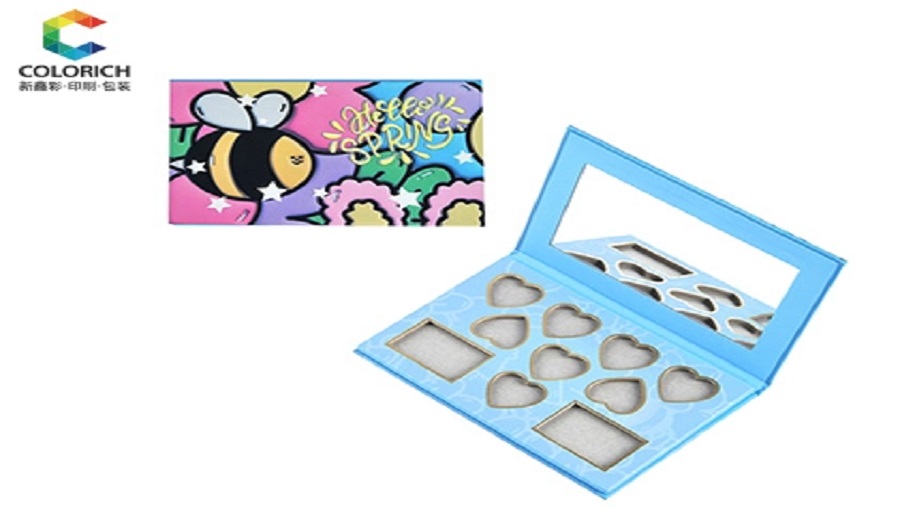
Special shape paper boxes from one die pass each: geometric, object, character and window families.
The test has two parts. Can the silhouette be cut from a flat sheet in one die pass — including all its curves, scallops and cut-outs? And can the resulting shape be closed along a single straight glue seam? If both are yes, the shape is manufacturable in paperboard and what remains is pricing. If the shape needs a compound curve — a surface curving in two directions at once — or heat forming, it is not a paperboard part, and the honest answer is to change the shape rather than force the material.
This is why the shapes that look radical at retail are almost all flat-cut derivatives: heart, hexagonal box, butterfly, bear, book, fruit. Each is one die pass away from a standard box. See the special shape paper box product page for the range we produce.
Two exceptions are worth knowing: fully round tubes (rolled rather than folded, a different process) and shapes whose interior cut-outs leave the glue seam no path to run. Both are solvable; both change the cost base.
| Family | Examples we produce | Suits | Watch for |
|---|---|---|---|
| Geometric | Semicircle, hexagon, trapezoid | Distinct shelf silhouette at near-standard cost | Corners carry impact damage |
| Object | Book-style, notebook, envelope | Concept-led ranges, gifting | The object metaphor fixes the proportions |
| Character | Butterfly, bear, fruit | Seasonal launches, younger consumers | Small appendages add hand assembly |
| Window / half-open | Acrylic or film windows, half-lid reveal | Showing pan colours without opening | Film adds a static and scratch variable |
One of ours in production: the fruit-shaped eyeshadow palette — a character-family shape that ships, fills and stacks like a standard box.
Family choice is really a cost-position choice: geometric shapes ride standard tooling practice, while object and character shapes each carry their own die and assembly labour. The custom shaped boxes that work commercially are the ones that accept that trade from the start, rather than discovering it at sampling.
The most common shaped-box failure is not structural; it is volumetric. The outside is approved first, then the pans do not fit. Pan count and diameter set the minimum inner cavity, the mirror adds thickness the silhouette has to absorb, and magnet positions cannot sit on a tight curve because the steel plate they meet has to be flat enough to seat across. Run the inside layout first and the outside has room to be creative; run it last and the outside has to be redrawn.
What holds the pans inside a shaped cavity is its own decision — our guide to the right insert for palette packaging covers platforms, EVA and pulp options.
The same inside-first logic applies to the palette itself: sizes, proportions and how consumers read them are laid out in our guide to eyeshadow palette packaging design.
| Feature | How it fails | Handling rule |
|---|---|---|
| Sharp external corners | They collapse first under impact; the wrap whitens at the point | Give every outside corner a radius, however small |
| Fold lines across decorated panels | Film and foil crack at the crease | Draw the finish map and the crease map together |
| Narrow glue tabs on curves | Adhesive starves along the curved seam; the box opens in transit | Widen tabs on curved seams — curve cost hides in glue area |
| Cut-outs near the seam | The seam has no path left; the shape cannot close | Plan cut-outs against the seam line, not after it |
None of these forbids a shape; they price it. A brief that arrives with corner radii and seam awareness already drawn costs less to quote, because the diecutter does not have to redesign it.
Five drivers, each with its own lever:
Lead time on the product page runs 20–35 days from final confirmation; shaped projects sit at the top of that band when the die is new. Send the shape sketch and the pan layout through the contact page and we will tell you what the shape costs you in tooling and hand assembly — before you commit artwork.
Small panels take foil, but each small area may need its own foil plate — a logo spanning three separate panels is three plates, not one. Curved surfaces only accept flat-process printing where the wrap contacts the former flatly; true curves take no print at all, which is why shaped boxes concentrate their branding on the largest flat panel.
The design rule that follows: put the branding where the panel is big, flat and away from folds, and let the shape itself carry the distinctiveness everywhere else. Fighting for print on a small curved cheek of a butterfly wing costs plates and rejects for a result nobody reads at shelf distance.
Dielines for shaped boxes carry more of these constraints than standard ones; the dielines and safe zones guide shows how to mark them.
Approve against all five or hold. A shaped sample that passes three and "looks great" is the most expensive approval in packaging, because the die is already cut.
If the shaped format needs a closure rather than a plain seam, the four magnetic closures and where each sits are covered in the magnetic closure types guide.
Yes, within the flat-cut rule: if the shape can be die-cut from a flat sheet and closed on a straight seam, we quote it. Sketches that need compound curves or heat forming come back with the nearest paperboard-feasible alternative and the reasons, before any tooling is discussed.
MOQ is listed on the product page as negotiable per project, because shaped tooling changes the economics of small batches. Send the quantity you have in mind with the shape, and the quote will state the batch it is based on.
Die tooling is quoted as its own line, not buried in unit price. That keeps the tooling cost visible and lets it be amortised across reorder quantities — which is usually the difference between a shaped box being expensive and being merely different.
Yes, where the magnet positions sit on flat panels. Magnets need a flat seat on both sides of the closure, so a shape with magnet positions on a curve is revised before it is quoted — the closure types guide linked above shows the four options and where each sits.
The product page quotes 20–35 days from final confirmation. A new die sits at the longer end of that band; repeat orders on an existing die sit at the shorter end.
Hey,I'm Rachel Liao,the sales manager of Colorich Packaging.
With solid professional skills and acute market insight, focus on providing customers with customized packaging solutions and supply chain optimization services.
●Packaging demand analysis and solution design
●Customer development and long-term relationship maintenance
●Cost optimization and sustainable packaging practices

 en
 English
 日本語
 한국어
 français
 Deutsch
 Español
 italiano
 русский
 português
 العربية