
A makeup packaging box has to survive three tests the brand never watches: going up on the filling line, taking ink and labels, and surviving the pack-out. The brand sees the unboxing; the filling line sees whether the box erects without jamming, takes a bottom label without slipping, and stacks in a carton without crushing. Specifying for the unboxing and ignoring the rest is how a beautiful box ends up hand-turned on a line designed for machines. This page walks the six stations a box passes through, the structure choices that decide line speed, the decoration details that fight the line, four ways to pack out, and the eight questions to send your filler before artwork approval.

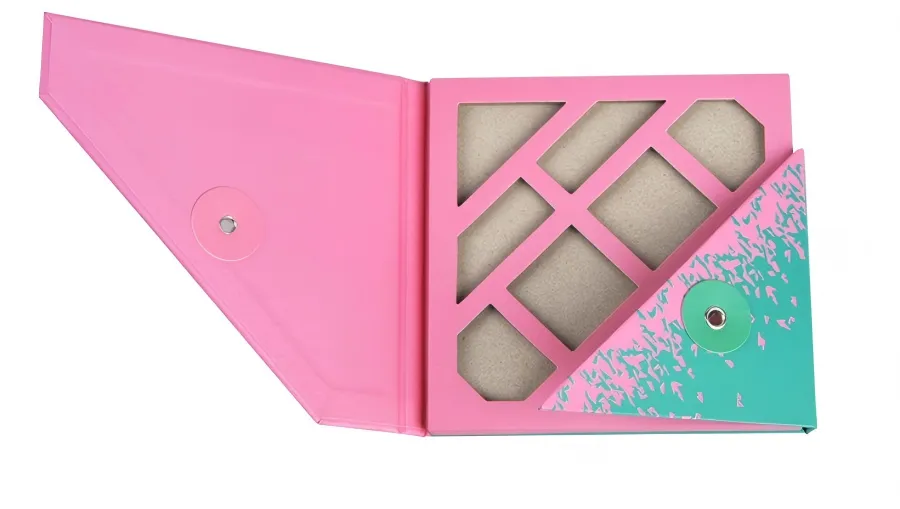
A makeup packaging box with inserts: what the brand sees at unboxing, and what the filling line has to run.
Loading, labelling, packing. Each has its own failure mode, and none of them is visible in a sample that only gets opened by hand on a desk. A box that erects cleanly by hand can still jam a hopper. A wrap that photographs beautifully can still slip under a labelling head. A carton that looks full can still crush the first row in transit. The full structure range we build against these constraints is on the makeup packaging box product page.
The rest of this page assumes one setting: contract filling, batch quantities, machine or assisted labelling, third-party warehousing. If everything is hand-assembled in-house, roughly half of it is already solved.
Six stations, each with its own check:
The first two stations decide the batch: a crooked erection multiplies into crooked labelling and a pack-out that will not close. That is why sample approval should be run through erection, not just admired.
Upstream of all this sits the component decision — how the custom eyeshadow palette packaging that goes inside the box gets manufactured is covered in our production walkthrough.
| Structure | On a filling line | Watch for |
|---|---|---|
| Auto-bottom foldable | Erects fastest by hand or machine; no tooling | Holding force on heavy loads |
| Snap / lock bottom | Machine-assisted erection | Crease quality decides the jam rate |
| Interlocking tabs | Light loads only; fast but weak | Not for multi-piece sets |
| Pre-glued magnetic shell | No body erection; closes in one press | Highest unit cost; magnet seating checked per batch |
| Lid-and-base rigid | Two-piece handling; slower but presentation-grade | Lid and base pairing, gap control in pack-out |
Where the foldable structures come from and how they ship flat, see the flat-ship erection methods guide.
| Decoration | Line conflict | Counter |
|---|---|---|
| Film lamination | Slips under vacuum or friction-fed labelling heads | Leave the label window un-laminated, or specify matte film |
| Spot UV | Height difference confuses pick-and-place suction | Keep UV off pick faces and label windows |
| Magnets | Metal detection at the line can flag the closure | Agree detector settings with the filler before the magnet spec is fixed |
| Film windows | Static makes film cling and attracts dust | Earth the station; keep windows off the label face |
| Foil on the label area | Label adhesion drops on foil | Keep foil out of the label rectangle |
The magnet point is structural as well as decorative; the magnetic closure types guide covers where magnets sit and why.
Pick by what the receiving end can absorb: a line that erects boxes anyway takes flats happily; a line tuned for pre-erected magazines needs boxes to arrive standing and square. Scuff-prone soft-touch wraps argue for bagging regardless of the other two choices. The drawer paper box product page specs bubble wrap plus outer carton as the standard export pack, and foldable structures ship flat by design.
Copy the list, fill in your answers, and send it through the contact page with the cartoner model and pack-out — we will come back with the box spec that runs on it.
The product page publishes MOQ at 500–10,000 pieces and lead time at 20–35 days from final confirmation. Read those against the filling schedule backwards: lead time starts at final artwork confirmation, so artwork approval is the last point where structure, label window and pack-out can still be changed for free. The eight questions above belong before that point.
The sequence in practice: quote and structure agreed, sample run through erection and labelling, artwork locked, production inside the 20–35 day band, then line go-live.
If the filler itself is not chosen yet, our guide to 5 checks before choosing a manufacturer covers what to verify before the box ever gets specced.
Yes, and for fillers it is often the cleaner route: one spec, one MOQ band — 500–10,000 pieces per the product page — and delivery aligned to the filling schedule. The brand approves artwork and samples; matching box arrival to line time is simpler when the box ships to the filler directly.
Ask the line. A line with an erection station, or hand time budgeted, takes flats and saves cube; a line tuned for pre-erected magazines needs boxes standing. The wrong answer here turns a machine line into a manual one, which is why it is question one of the eight above.
Nothing automatic. Magnets do not make a box unusable, but they can trip a detector set for the product rather than the packaging. The answer is agreed at spec stage: detector settings confirmed with the filler, magnet positions marked on the dieline, and if the line cannot be set around them, a non-magnetic closure is substituted. The magnetic closure guide above covers the alternatives.
Yes, and it is the fallback when a wrap will not key a label: late-stage labelling at a separate station or by hand. It costs a handling step and still needs the label area reserved — so the artwork has to leave the label window plain either way, or the fallback has nothing clean to stick to.
Shaped tooling and pre-glued magnetic shells raise the batch at which setup costs spread thin, and new-tool projects sit at the top of the 20–35 day band. The product page figures are the public baseline; the quote states the batch and the date it is built on.

Hey,I'm Rachel Liao,the sales manager of Colorich Packaging.
With solid professional skills and acute market insight, focus on providing customers with customized packaging solutions and supply chain optimization services.
●Packaging demand analysis and solution design
●Customer development and long-term relationship maintenance
●Cost optimization and sustainable packaging practices

 en
 English
 日本語
 한국어
 français
 Deutsch
 Español
 italiano
 русский
 português
 العربية