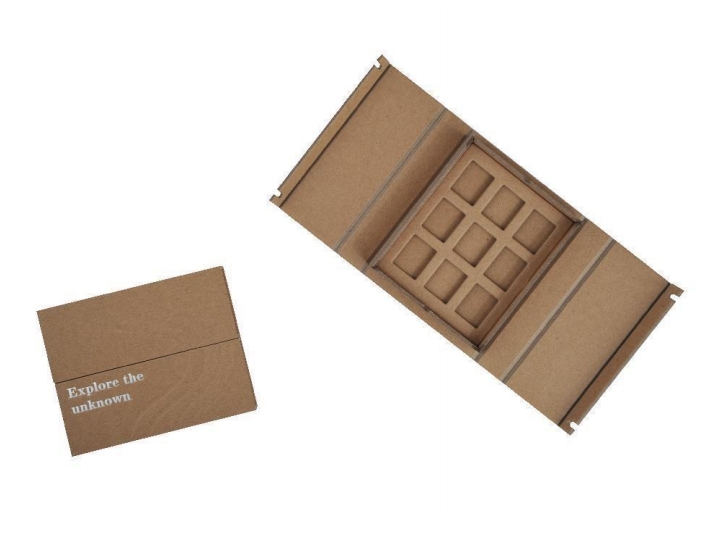

A foldable paper box is the right call when three things are true at once: the order volume is large enough that freight cube matters, the labour to erect boxes costs less where they will be filled than the cube you save, and the box does not have to survive repeated opening cycles. Flat-ship converts one cost into another — it moves money from freight and warehousing into erection labour and finish risk. This page covers what flat-ship saves and what returns, four ways to erect the box, why some finishes crack at the crease, where foldable boxes fail in transit, and a checklist for choosing between foldable and rigid for one SKU.

Foldable paper boxes for cosmetic sets, shown erected; they ship flat and are assembled at the filling site.
Flat-ship is a bet on volume. Shipped flat, a foldable gift box occupies a fraction of the cube of its erected form, so freight and warehouse slots are cheaper per unit; erected at the filling site, that saving is paid back in labour minutes per box, in rework when flats arrive crushed, and in the quality risk that comes from every box being assembled at the last minute. The bet pays when cube is the expensive part: bulk sets, sea or inland freight, long storage. It loses when presentation is the expensive part: retail-ready boxes that must stand perfectly square straight out of the carton.
For the structures this applies to — crease folds, snap closures, interlocking tabs and pre-glued magnetic shells — see the foldable paper box product page.
Four things are saved, three come back. Estimate both per order before committing; the two lists multiply, they do not compare directly.
Saved:
Returns:
No money figures appear here on purpose: the four saves and three returns are priced differently in every market. The point of the list is that the comparison is four columns against three, and most brands count only the first two.
| Method | Needs equipment? | Suits | Batch logic |
|---|---|---|---|
| Auto-bottom | No — springs open when the sides are squeezed | Light-to-medium loads, hand lines | Fastest per box by hand; no tooling |
| Snap / lock bottom | Optional — faster with a simple press | Medium loads | Hand-feasible, slow above small volumes; a bench press pays for itself quickly |
| Interlocking tabs | No | Light loads, shallow sets | Simplest structure, least board, lowest holding force |
| Pre-glued magnetic shell | No body erection — arrives shaped | Premium gift sets, high unit value | Zero erection labour on the line; highest unit cost |
The batch criterion that matters is not a piece count — it is whether erecting needs a dedicated device. If it does, that device has to live somewhere and be justified by volume; if it does not, the choice is a labour question, not a capital one. For how these structures behave against a filling line's stations, see the filling-line box specs guide.
Paperboard remembers folds. A crease made across the grain at the right pressure recovers cleanly box after box; a crease pressed too hard cuts fibres and the fold eventually whitens and splits; a crease too light springs back and the box never sits square. Fibre direction is the variable most often missed: creases running with the grain stay crisp, creases across the grain resist. A dieline that puts its fold lines in one grain direction erects squarer than one that mixes them.
Coating adds to the problem. The thicker the film or coating across a crease, the more it resists recovery and the more visible the crease becomes after two or three cycles. For boxes expected to open repeatedly — a drawer-in-sleeve format, a refill shell — keep the heavy finishes off the fold lines.
Which finish sits where is a dieline decision. Our guide to dielines and safe zones shows how to mark it so the printer and the diecutter agree.
Three failure points, in order of how often they show up:
Each of these is a pack-out decision as much as a structural one, which is why sample approval should include one flat-packed carton that travels the real route before the order ships.
| Question | Favour foldable when | Favour rigid when |
|---|---|---|
| Loaded weight per box | Light to medium; the folded structure carries it | Heavy or multi-row; needs solid board walls |
| Reuse expectation | Opened once or twice | Opened repeatedly; crease memory will show |
| Transit mode | Sea, inland, consolidated freight — cube is the cost | Air or premium courier — protection matters more than cube |
| Batch and equipment | Large batches; hand erection acceptable | Small batches, or a line that cannot spare labour |
Rigid is not an upgraded foldable — the two answer different briefs, and some ranges split deliberately: rigid for the hero SKU, foldable for the refill or seasonal set. For the magnetic end of rigid, see the magnetic closure types guide; for drawer structures, see the drawer tier layout guide.
One thing foldable wins outright: material efficiency. What that means in compliance paperwork for 2026 is covered in our guide to eco compliance for foldable packaging.
Send the SKU list and destination market through the contact page and we will say which of the two pays off — with structural drawings and printed samples included in the quote.
It depends on board caliper and structure, which we set per project, so there is no single honest number to quote here. What holds generally: auto-bottom and snap-bottom folds carry medium cosmetic loads — palettes, bottle sets — comfortably when the board is specified for the weight, and interlocking tabs are for light loads. Send the loaded weight per piece and the answer comes back with a structure, not a guess.
Yes — the pre-glued magnetic shell is exactly that: a rigid-faced shell that ships flat and completes into a magnetic-closure box in one motion. It is the premium end of the foldable range, where the closure feel of a collapsible rigid box is wanted without its freight cube.
Flat storage is what foldable is designed for; the risk is not duration but pressure. Flats stored under heavy stacks or on edge take a set that shows after erection. Store them flat, in the stack height they ship in, and the creases recover normally. If flats have been compressed for months, sample-erect a few before committing the line.
Auto-bottom and snap-bottom styles run on standard cartoning equipment, which is why they dominate filling-line work. Interlocking tabs and pre-glued magnetic shells are hand or semi-automatic operations. Match the structure to the machine before artwork, not after — the filling-line specs guide above lists the questions to ask.

Hey,I'm Rachel Liao,the sales manager of Colorich Packaging.
With solid professional skills and acute market insight, focus on providing customers with customized packaging solutions and supply chain optimization services.
●Packaging demand analysis and solution design
●Customer development and long-term relationship maintenance
●Cost optimization and sustainable packaging practices

 en
 English
 日本語
 한국어
 français
 Deutsch
 Español
 italiano
 русский
 português
 العربية