
A drawer paper box is decided in the first drawing, not on the samples: map the product list to drawer count and tier height first, and the artwork will fit; draw the outside first and the drawers will jam or the tiers will not close. Whether a drawer slides cleanly comes down to how the board and the wrap work together — not to how carefully it was "made". This page covers when a drawer beats a lid-and-base box, how to map a product list to tiers, the three variables that cause jamming, which insert holds compacts and bottles inside a sliding drawer, and how to approve the sample.
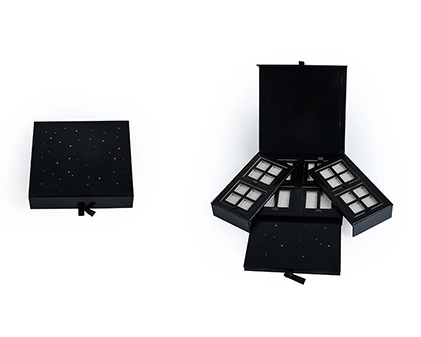
A folding drawer paper box: the drawer runs in the sleeve, so board and wrap thickness set the clearance.
Three conditions, any two of which justify a drawer: more than one product in the box, products the consumer takes out and puts back (so the box opens repeatedly), and a presentation need for layers that reveal in sequence. With a single product opened once, a lid-and-base does the same job for less structure.
The drawer paper box product page shows the variants — tiered compartments, adjustable dividers, dust and light shielding, and the foldable drawer sleeve — and doubles as the landing page for buyers searching a cosmetic drawer paper box supplier.
| Product situation | Layout that fits | Why |
|---|---|---|
| One tier, few items | Single drawer, one platform | Depth follows the tallest item; one motion reveals everything |
| Compacts plus a taller item | Two tiers — compacts flat on top, bottles standing below | Compacts want to lie flat; bottles want to stand; never share a tier |
| Full routine set | Three tiers ordered by usage sequence | Tiers reveal in the order the routine runs; heaviest tier sits lowest |
| Mixed heights, many SKUs | Drawer with adjustable dividers | Dividers absorb the SKUs that change between sets |
Two rules survive every layout. Tier height is set by the tallest item on that tier plus room to lift it out. And anything glass sits on its own fixed platform, never loose on the drawer floor — a rigid drawer box that lets a bottle ride loose is one delivery van away from a claim.
A drawer that sticks is not a craftsmanship problem; it is three variables drifting at once. Board thickness: thicker greyboard tightens the channel the drawer runs in, and the tolerance stacks across the walls rather than in one place. Wrap thickness: every layer of paper inside the channel eats clearance the drawing never showed. Humidity: paper moves with moisture, so a drawer that slid cleanly in the dry factory can bind in a humid warehouse.
The test that catches all three: take the sample drawer, leave it in the room where the boxes will be stored for a day, then slide it ten times with the product loaded. A drawer that runs clean unloaded can still bind loaded, because the load flexes the drawer floor. Insist the sample is made from the same board and wrap as production — a sample cut from different stock proves nothing about clearance.
Clearance lives on the dieline like every other dimension; the dielines and safe zones guide shows where to mark it.
A drawer moves, so its insert has to move with it — anything relying on friction to the drawer floor slides to the back on the first pull. The three inserts we use behave differently:
The distinction that matters: compacts want to lie flat on something rigid; bottles want to stand in something cut to their shape. A layout that puts both in the same insert usually does neither well. Insert selection beyond drawers — trays, platforms, neck cradles — is covered in the guide to the right insert for palette packaging.
If the marketing plan says "pull the drawer out on shelf", the retention stop is not optional. A drawer that comes off in a customer's hand reads as a broken box.
Six inputs make a drawer box quotable in one round: product list with piece count and dimensions, the tallest item per tier, intended tier layout, insert preference, pull and stop preference, and quantity.
Approve the sample against four checks:
Send the product list with piece counts and heights through the contact page and we will map it to drawers before you draw the artwork — structural drawing and printed sample included.
If the brief moves away from drawers, the same product list maps onto other structures: the magnetic closure types guide covers closure-led formats, and the flat-ship erection methods guide covers freight-led ones.
Yes, with the retention stop engineered for it: a full-extension drawer needs the stop to hold at full travel rather than partway, and the sleeve walls to run true along the whole depth. It costs clearance discipline — the variables in the jamming section above all get less margin — so it is quoted against the loaded weight.
Yes. A snap catch on the drawer face holds it closed in transit where friction alone would let it drift. It is most useful on single-drawer sleeves; on multi-tier boxes an outer sleeve or band does the same job without adding a component inside the channel.
Usually yes, when the insert locates into the drawer corners rather than being glued in. The platform dimensions are held by the drawer, so a changed product list means remaking the insert alone. This is why we draw inserts as a separate component with its own dimensions, not as part of the drawer drawing.
Practically, yes. Every tier adds height to the sleeve and depth to the clearance stack, and tiers beyond three start to fight the drawer's opening height — the box gets taller than the shelf allows before the tiers add much. Two to three tiers covers most cosmetic sets; beyond that, a lid-and-base with trays usually wins on usability.
This page does not quote a lead time; the drawer paper box product page and the quote itself carry the current figures for your structure and quantity. What is fixed is the process: structural drawing first, then sample, then production — so the clearance decisions above are settled before tooling.

Hey,I'm Rachel Liao,the sales manager of Colorich Packaging.
With solid professional skills and acute market insight, focus on providing customers with customized packaging solutions and supply chain optimization services.
●Packaging demand analysis and solution design
●Customer development and long-term relationship maintenance
●Cost optimization and sustainable packaging practices

 en
 English
 日本語
 한국어
 français
 Deutsch
 Español
 italiano
 русский
 português
 العربية