
A magnetic paper box rarely fails because the magnet is too weak. It fails because the closure form does not match the product format, because the magnets sit in the wrong place relative to the hinge, or because the board and the wrap leave the wrong room for them. Those three decisions are made at the spec stage, long before artwork. This page covers the four closures we build for cosmetic sets, how many magnets go where, why stronger is usually worse, what a magnetic strip means at end of life, and the fifteen-minute check that catches a bad lot before it ships.

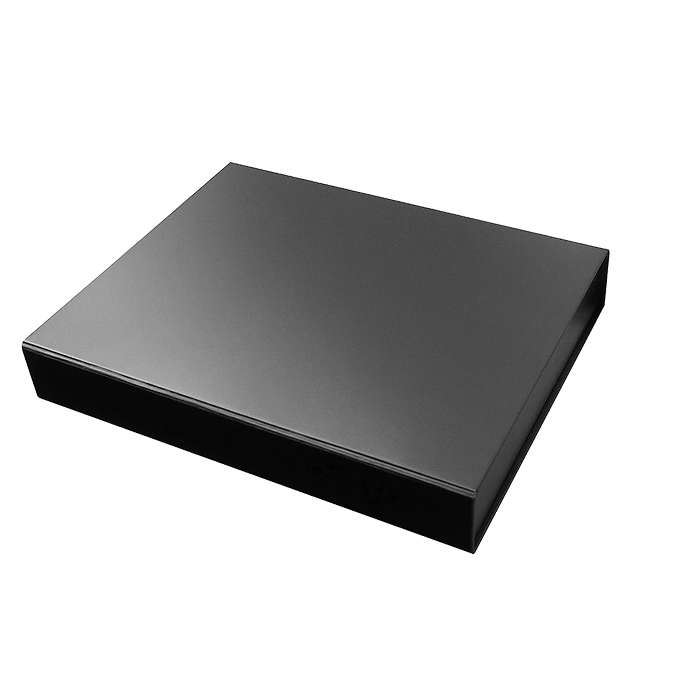
A custom printed magnetic paper box: the lid and tray are separate pieces, so the magnet line has to stay parallel to the hinge.
Choose the closure after the format is fixed — single compact, multi-piece gift set, refillable palette — never before. Ranking closures by unit price and picking the cheapest that looks acceptable is how a heavy gift-set lid ends up held by two small magnets, and how a cover that should fold once ends up with extra parts that drift out of alignment in production. The reasoning only holds once two facts are settled: how much the loaded lid weighs, and how often the box will be opened. A closure suited to a slim palette opened twice at retail will not survive a nine-piece set a consumer opens every month.
For the full range of structures we build with this closure, see our magnetic paper box product page.
Each closure differs in how it is assembled, and assembly steps are where batch consistency is won or lost: every extra step is one more place for magnet position to drift.
The cover and tray are one piece, folded once around the load, with magnets seated in the front flap meeting the tray edge. Because the geometry is folded rather than built from separate parts, alignment is controlled by the crease pattern. It suits palettes and single-format products with a fixed silhouette. It turns over when the product is a deep, multi-row set: the folded cover needs depth the crease pattern cannot give without losing squareness.
Two separate pieces; magnets sit in the lid rim and meet steel hidden in the base rim, so a box with a magnetic lid can be as deep as the product requires. The cost is assembly: lid and base must stay parallel through wrapping and gluing, and any twist in the lid shows as an uneven gap. It suits gift sets and rigid multi-piece sets — the classic magnetic closure rigid box format for premium launches.
A hinge line at the back, magnets at the front edge. The lid is an integral flap rather than a separate piece, so assembly complexity sits between the two above. It suits small singles — a compact, a mini palette — where a full lid would visually dominate the product.
A paper tray carries a soft iron sheet; the closure is completed by magnets fixed in the shell. Because the magnetic part is flat and flexible, the pan card can be swapped out for refills. It suits refillable and repeat-purchase formats. Its limit is holding force on vertical surfaces: rely on it for flat, horizontal closure, not for a lid that must hold its own weight upright on display.
| Closure | Built for | Assembly risk | Where it struggles |
|---|---|---|---|
| Book-style | Palettes, single formats | Lowest — folded once, fewest parts | Deep multi-row sets |
| Lid-and-base | Gift sets, heavy loads | Highest — two pieces to keep parallel | Slim singles, where the rim adds bulk |
| Flip-top | Small singles | Middle — hinge plus front magnets | Wide lids without centre support |
| Soft-magnetic core | Refillable palettes | Low — but pan card must seat true | Vertical holding force |
These are closures for the box shell. If the question is the palette itself — pan layout, refills, mirrored lids — our custom magnetic makeup palette guide covers that side of the decision.
Specify the weakest magnet that still closes the loaded lid against its own weight and transit inertia, not the strongest the pocket can take. Extra pull has to come from somewhere: a thicker magnet needs a deeper pocket in the same greyboard, and once the pocket goes too deep, the wrap over it telegraphs every magnet edge as a ridge.
Over-strong closures show up in three ways. The wrap puckers around the pocket as the magnet pulls the board in while seating. The lid becomes hard to open one-handed, which matters for retail testers and older consumers. And the closure fights the hinge, so repeated opening twists the lid out of square instead of letting it rotate flat.
If you cannot describe the loaded weight of the lid, you are not ready to brief magnet strength. Describe the load and the opening frequency, and let the closure be chosen against them.
Two magnets, set towards the middle of the side edges, close a narrow lid. Four magnets, one near each corner but pulled in from it, close a wide lid — corner placement alone lets the mid-span of the lid bow between the magnets. What matters more than count is geometry: magnet centres on a line parallel to the hinge, poles paired so every magnet attracts rather than fights its neighbour, and enough hinge-line clearance that the lid rotates without the magnets scraping the steel.
Placement errors surface after weeks of use, not on day one. A quick early check: close the box on a flat table and sight across the lid. If a corner lifts before the magnets seat, the magnet line is not parallel to the hinge. Fix that in the diecut and crease pattern — not by swapping in stronger magnets, which only presses the twist harder into the wrap.
The same closure design can hold for years on one board and go slack within months on another. Greyboard thickness decides whether the magnet can be buried flush; wrap paper thickness decides the closing gap; and film lamination lowers surface friction, which lets a correctly seated magnet slide inside its pocket during transit.
Two spec rules follow. First, cut the magnet pocket with the actual board caliper in hand, not from a standard value — a pocket sized against a different board leaves the magnet either sitting proud under the wrap or buried so deep the pull weakens. Second, if the wrap is laminated or soft-touch coated, ask for the magnet pockets to be fixed with adhesive, because friction alone will not keep them put through shipping.
Magnet positions belong on the dieline, not in a side note. Our cosmetic packaging artwork checklist shows where to mark them so the diecutter and the assembly line read the same drawing.
A magnetic strip has to be removed before the paper can be recycled — this is stated on the magnetic paper box product page itself. That makes the closure a poor fit for one-way, high-volume distribution, where the consumer will never take the box apart and the strip goes into the paper stream with everything else.
Where that trade-off does not work, three closures recycle with the box intact:
None of them gives the snap-open feel of magnets; all of them remove the disassembly step. For the full arithmetic on when eco options actually save money, see our guide to affordable eco friendly packaging.
A magnetic closure box can be quoted properly from seven inputs: product dimensions and loaded weight per piece, opening frequency, pack-out method, shipping mode, finish requirements, quantity, and target market. Send those and the closure choice comes back with reasons, not just a price.
When the sample arrives, fifteen minutes and no equipment cover the six checks that catch most bad lots:
If a check fails, the batch decision is one of three: rework if the fault is in assembly (magnet seating, seams); concession if the fault is cosmetic and the lot is time-critical; reject and re-cut if the fault is in the diecut or the board, because that fault will repeat on every box in the lot.
If the format turns out not to suit a magnetic closure, the other structures cover most of the rest: see how flat-ship erection methods work for foldable formats, or how drawer tier layout is planned from the product list.
Send the product size, loaded weight and pack-out through our contact page and we will come back with the closure that holds — with the structural drawing and printed sample options listed alongside.
A magnet held by a pocket cut to the actual board caliper, and fixed against laminate friction, stays seated through normal use. The failures we see come from pockets cut off a standard value, or unfixed magnets under soft-touch film sliding in transit. Fix both at spec stage: pocket depth against the real board, and adhesive wherever the wrap is coated. The fingertip check above exists to catch exactly this.
Yes, with one precaution. Carriers and freight screeners can flag packages containing magnetic material, so declare the magnetic components when booking air freight and ship samples with the closures seated. The box itself is paperboard and wrapped board, with no restricted substances involved.
Yes — a drawer face can carry magnets that hold it closed while the drawer runs in the outer sleeve. It adds a second alignment requirement: the magnets must seat before the drawer is fully home, or the face pulls the drawer out of square. For tier planning, see the drawer layout guide linked above.
Yes, when the magnet is buried under the wrap with no external interruption. The visual limit is wrap thickness: thin wraps can telegraph a magnet edge as a shallow ridge under raking light. If the design has foil or a soft-touch panel, put the magnet under a plain area — texture changes over a buried magnet are easier to see on a textured panel than on a flat colour.
Pull the magnetic strip or the steel receiving plate out before the box goes into paper recycling; both come free once the wrap is opened at the pocket. The remaining board and paper are standard paperboard. If your market requires a recyclability claim, phrase it as "recyclable with the magnetic strip removed" — not as unconditionally recyclable.

Hey,I'm Rachel Liao,the sales manager of Colorich Packaging.
With solid professional skills and acute market insight, focus on providing customers with customized packaging solutions and supply chain optimization services.
●Packaging demand analysis and solution design
●Customer development and long-term relationship maintenance
●Cost optimization and sustainable packaging practices

 en
 English
 日本語
 한국어
 français
 Deutsch
 Español
 italiano
 русский
 português
 العربية